
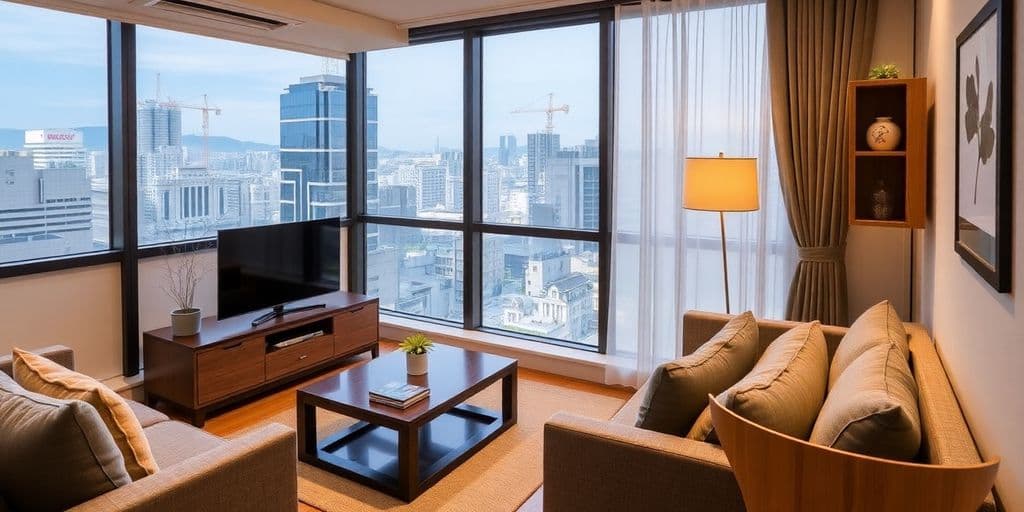
Tokyo's serviced apartment market spans 20 published listings across eight wards — from budget-friendly Akasaka to ultra-premium Marunouchi — all bookable through Moveandstay's Tokyo directory. This guide cuts through the noise with real prices, neighbourhood-by-neighbourhood breakdowns, and honest brand assessments drawn directly from our listings, so you can choose with confidence and move in without surprises.
Serviced apartments in Tokyo: the quick answer
A serviced apartment is a fully furnished flat — complete with a proper kitchen, in-unit laundry, and hotel-style housekeeping — rented on a flexible term that can run from a few nights to a year or more. Unlike a standard Tokyo rental (which typically demands a guarantor, key money, and a two-year lease), a serviced apartment is move-in ready on day one, with all utilities, Wi-Fi, and basic services bundled into the monthly rate.
They suit a wide range of residents: the corporate assignee who needs a comfortable base without a bureaucratic letting process; the relocating professional who wants a month or two to find their feet before committing to a longer lease; the family on an international transfer that needs proper bedrooms and a kitchen; and the frequent long-stay traveller who finds a hotel room feels cramped after a fortnight. What they share is a preference for space, privacy, and self-sufficiency — things Tokyo hotels rarely deliver at a comparable price point.
Browse the full selection at serviced apartments in Tokyo.
What a Tokyo serviced apartment actually includes
The standard package across our Tokyo listings goes well beyond a bed and a desk. Here is what you can reliably expect:
- Fully equipped kitchen. Hob (gas or induction), microwave, refrigerator, rice cooker, and a full set of pots, pans, plates, and cutlery. You can cook a proper dinner from day one without buying a single item.
- In-unit laundry. Almost every apartment has a washing machine; many have a combined washer-dryer. An English-language instruction card is usually posted on the machine — a small but genuinely useful touch.
- High-speed Wi-Fi. Included in all listings. Japan's fibre infrastructure is excellent; connections are generally fast enough for video calls and 4K streaming. Check individual listings if you need speeds above 300 Mbps for a dedicated work setup.
- Regular housekeeping. Frequency varies — daily or every-other-day at the premium end, weekly at mid-range — but all our listings include some scheduled cleaning rather than leave it entirely to the resident.
- 24-hour front desk or call centre support. Particularly important in Tokyo if you are arriving late at night or need help navigating Japanese utility bills or local paperwork.
- Utilities included. Electricity, gas, and water are bundled into the monthly rate at most properties, removing the hassle of setting up Japanese utility contracts in a foreign language.
- On-site amenities (varies by property). Higher-end buildings offer fitness centres, rooftop lounges, business centres, and concierge services. MIMARU properties are particularly well-regarded for family-friendly common areas; Oakwood Premier's Marunouchi building includes an executive lounge.
The practical upshot: arriving in Tokyo with two suitcases and walking into a fully functional home — fridge stocked if you have time at a convenience store on the way — is entirely realistic with any of the properties on our list.
How much does a serviced apartment in Tokyo cost?
Based on the serviced apartments we currently list in Tokyo, monthly rates range from ¥220,500 to ¥1,005,000, with a median of ¥405,000. The table below shows the 12 properties with published prices. Eight further listings are available at monthly rates on request — you'll find them linked in the neighbourhood and brand sections below.
| Monthly from (¥) | Property | Brand | Neighbourhood (Ward) |
|---|---|---|---|
| ¥220,500 | MetroResidences Japan | MetroResidences | Akasaka (Minato) |
| ¥330,000 | Oakwood Apartments Minami-Azabu | Oakwood | Minami-Azabu (Minato) |
| ¥330,000 | Somerset Ginza East Tokyo | Somerset | Ginza (Chuo) |
| ¥390,000 | Oakwood Apartments Shirokane | Oakwood | Shirokane (Minato) |
| ¥390,000 | Oakwood Residence Shinagawa | Oakwood | Shinagawa (Minato) |
| ¥399,000 | Somerset Shinagawa Tokyo | Somerset | Shinagawa (Minato) |
| ¥405,000 | Citadines Shinjuku Tokyo | Citadines | Shinjuku |
| ¥450,000 | Oakwood Apartments Nishi-Shinjuku | Oakwood | Nishi-Shinjuku (Shinjuku) |
| ¥555,000 | Oakwood Residence Aoyama | Oakwood | Aoyama (Shibuya) |
| ¥660,000 | Oakwood Hotel & Apartments Azabu | Oakwood | Azabu (Minato) |
| ¥999,000 | Ascott Marunouchi Tokyo | Ascott | Marunouchi (Chiyoda) |
| ¥1,005,000 | Oakwood Premier Tokyo | Oakwood | Marunouchi (Chiyoda) |
What drives price? Four variables do most of the work:
- Ward and neighbourhood. Chiyoda (Marunouchi) is Tokyo's most prestigious business address — hence the two ¥999,000–¥1,005,000 listings there. Minato covers a wide range: Akasaka starts at ¥220,500, while Azabu commands ¥660,000. Shinjuku and Chuo sit comfortably in the mid-range.
- Brand tier. Oakwood, Ascott, and Somerset operate at different service levels. Oakwood Premier and Ascott are flagship luxury properties; Citadines and MetroResidences compete more on value.
- Apartment size. Our Tokyo listings run 1–2 bedrooms. A two-bedroom unit in the same building typically costs 20–40% more than a one-bedroom.
- Length of stay. Nearly all operators offer better monthly rates for stays of three months or more. If you are committing to six-plus months, it is always worth asking for a long-stay rate — savings of 10–20% are not unusual.
For broader market context on what you'll pay for housing in Tokyo, see our guide to monthly rent in Tokyo.
Choosing your area: a Tokyo neighbourhood guide
Tokyo's 23 special wards are very different places to live. Our listings are concentrated in eight of them. Here is an honest summary of each.
Minato — Akasaka, Azabu, Minami-Azabu, Shirokane, Shinagawa
Minato is the most represented ward in our Tokyo collection (six listings), and for good reason: it is where much of Tokyo's international business community lives and works. Akasaka is dense with embassies, multinational offices, and mid-range restaurants that stay open late — MetroResidences Japan at ¥220,500/month makes it the most accessible option in a premium ward. Azabu and Minami-Azabu are leafier and quieter, popular with expat families; Oakwood Hotel & Apartments Azabu and Oakwood Apartments Minami-Azabu anchor the neighbourhood. Shirokane has a village-like feel with excellent cake shops and boutique restaurants along its main street — Oakwood Apartments Shirokane is a reliable choice. Shinagawa is less glamorous but supremely practical: it is a Shinkansen hub and has direct access to Haneda Airport, making it ideal for frequent travellers; both Oakwood Residence Shinagawa and Somerset Shinagawa Tokyo are here.
Chiyoda — Marunouchi, Akihabara
Chiyoda is Japan's administrative and financial core — the Imperial Palace, the National Diet, and the Tokyo Stock Exchange all sit here. Marunouchi specifically is Tokyo's answer to the City of London: glass towers, expense-account restaurants, and a very short walk to Tokyo Station (the country's best-connected rail hub). It is expensive, but if your office is here, the commute-free lifestyle has genuine value. Oakwood Premier Tokyo (¥1,005,000/month) and Ascott Marunouchi Tokyo (¥999,000/month) are both flagship-tier. Akihabara, on the eastern edge of Chiyoda, is a different world: neon-lit electronics shops, anime culture, and excellent ramen. MONday Apart Premium Akihabara offers monthly rates on request for those who want central Tokyo at a more accessible tier. 1/3rd Residence Tokyo (also Chiyoda, rates on request) adds a fourth option in this well-connected ward.
Shinjuku — Shinjuku, Nishi-Shinjuku
Shinjuku Station is the world's busiest rail station — over three million passengers a day — which makes the surrounding wards extraordinarily well-connected. Nishi-Shinjuku (west Shinjuku) is dominated by skyscrapers and functions as a secondary CBD; it is calmer and more businesslike than the east side. East Shinjuku contains Kabukicho (entertainment district), Golden Gai (tiny atmospheric bars), and Shinjuku Gyoen (one of Tokyo's finest parks). Both Citadines Shinjuku Tokyo (¥405,000/month) and Oakwood Apartments Nishi-Shinjuku (¥450,000/month) are solid mid-range options; Citadines Central Shinjuku is also available at monthly rates on request.
Chuo — Ginza, Nihonbashi, Tokyo Station area
Chuo encompasses some of Tokyo's oldest merchant districts. Ginza is the luxury shopping and gallery quarter — understated elegance and expensive cocktails; Somerset Ginza East Tokyo at ¥330,000/month is good value for the postcode. Nihonbashi is a historic financial district undergoing a significant regeneration, with new restaurants and cultural venues opening regularly; MONday Apart Premium Nihonbashi (rates on request) is ideally placed for those working in banking or insurance. Near Tokyo Station, MIMARU Tokyo Station East (rates on request) is an excellent family option with its spacious layouts.
Shibuya — Aoyama
Aoyama occupies a quiet, design-conscious pocket between Shibuya and Minato. It is home to fashion houses, concept stores, and some of Tokyo's best coffee shops. The neighbourhood attracts creative professionals and brand managers who want Minato-level quality without the full Minato price — though Oakwood Residence Aoyama at ¥555,000/month is still firmly premium territory.
Taito — Ueno
Ueno is Tokyo's cultural anchor: the National Museum, Ueno Zoo, and a string of concert halls cluster around Ueno Park. The neighbourhood is more lived-in and less polished than Minato or Chiyoda, but that is part of its appeal. It is also more affordable. MONday Apart Premium Ueno (monthly rates on request) is ideal for researchers, academics, or anyone whose work takes them to the park's institutions.
Toshima — Ikebukuro
Ikebukuro is often overlooked by first-time Tokyo visitors in favour of Shinjuku or Shibuya, but it is a genuinely excellent base: two major department stores, a huge underground shopping complex, excellent ramen, and outstanding transport connections north and west. MIMARU Tokyo Ikebukuro (monthly rates on request) is a particularly good choice for families, given MIMARU's reputation for generous layouts and kid-friendly facilities.
Sumida — Asakusa area
Sumida sits across the Sumida River from Chiyoda and Taito, in what is arguably Tokyo's most atmospheric traditional quarter. Asakusa temple, the Tokyo Skytree, and old-town shitamachi streetscapes are all within a short walk. Petit Grande Miyabi (monthly rates on request) offers a distinctive boutique option here — right for those who want cultural immersion over corporate convenience.
For a broader look at where to base yourself, read our guides on the best neighbourhoods in Tokyo and best areas for expats in Tokyo.
The serviced-apartment brands in Tokyo
Knowing what each brand stands for helps you match expectations before you book.
Oakwood
The largest presence in our Tokyo collection with seven properties (¥330,000–¥1,005,000/month). Oakwood operates across three tiers in Tokyo: Apartments (practical, well-run, mid-range), Residence (larger units, more amenity-rich), and Premier (flagship luxury). All Oakwood properties are consistently reliable on housekeeping and maintenance — a strong choice for corporate assignees who need predictability. See all seven: Minami-Azabu, Shirokane, Shinagawa Residence, Nishi-Shinjuku, Aoyama, Azabu, and Premier Tokyo.
Ascott
One property in Tokyo — Ascott Marunouchi Tokyo (¥999,000/month) — and it is a statement address. Ascott is CapitaLand's ultra-premium brand, and Marunouchi is exactly where you would expect to find it. Exceptionally polished service, spacious layouts, and a location metres from Tokyo Station make this the natural choice for C-suite executives on assignment.
Citadines
Two properties in Shinjuku: Citadines Shinjuku Tokyo (¥405,000/month) and Citadines Central Shinjuku (rates on request). Citadines positions itself as smart, design-led, and accessible — a good fit for young professionals and those who want a central location without paying Minato or Chiyoda prices. Part of the Ascott group but a distinct, more compact tier.
Somerset
Two properties: Somerset Ginza East Tokyo (¥330,000/month) and Somerset Shinagawa Tokyo (¥399,000/month). Also part of the Ascott group, Somerset sits between Citadines and full Ascott in terms of price and positioning. Both Tokyo properties are spacious and well-equipped — particularly good for couples and families who want a homely feel rather than a hotel-adjacent experience.
MIMARU
A Japanese brand built specifically around family and group stays. MIMARU apartments are deliberately larger than the market norm, and the kitchen setups are taken seriously — multiple burners, proper fridge space, actual dining tables. MIMARU Tokyo Ikebukuro and MIMARU Tokyo Station East (both at monthly rates on request) are our two Tokyo listings. If you are travelling with children or sharing with colleagues, MIMARU is worth looking at first.
MONday Apart
Three properties in distinct Tokyo micro-markets: Akihabara, Nihonbashi, and Ueno (all at monthly rates on request). MONday Apart's "Premium" positioning reflects modern, well-designed apartments in interesting neighbourhoods — they tend to attract professionals who want somewhere with character rather than a generic corporate block.
MetroResidences
MetroResidences Japan in Akasaka (¥220,500/month) is the most affordable listed property in the collection. MetroResidences is a Southeast-Asian-rooted brand that has expanded into Japan with a straightforward, no-frills-but-properly-serviced proposition. Strong value for budget-conscious corporate travellers who still want a professional setup rather than an Airbnb.
Petit Grande
Petit Grande Miyabi in Sumida (monthly rates on request) is the boutique outlier in the collection. Smaller brand, more intimate property — ideal for those who find the global chains slightly soulless and prefer a place that feels like it belongs to its neighbourhood.
1/3rd Residence
1/3rd Residence Tokyo in Chiyoda (monthly rates on request) rounds out the collection with a flexible, modern approach to longer-stay living in one of Tokyo's best-connected locations.
Sizes and who they suit
All 20 properties in our Tokyo collection offer 1- or 2-bedroom configurations, sleeping between 2 and 4 guests. This shapes who each property is best for:
- Solo professionals. A 1-bedroom apartment gives you a proper separation between your living space and your sleeping space — something a hotel room never achieves. The kitchen means you can manage your own diet and costs. Any of the single-occupancy 1-bedroom units across the collection work well here.
- Couples. A 1-bedroom apartment works comfortably for two; a 2-bedroom gives you the option of a dedicated home office. Somerset Ginza and Somerset Shinagawa are particularly popular with couples for their homely feel.
- Families with one or two children. A 2-bedroom unit sleeping up to 4 is the right size. MIMARU properties are designed with families explicitly in mind — larger kitchens, more kitchen equipment, and common areas that children can actually use. Oakwood Minami-Azabu and Oakwood Shirokane are also well-regarded by expat families given their quiet, residential neighbourhood settings.
- Business travellers sharing accommodation. Two colleagues in a 2-bedroom apartment can each have their own room while splitting costs — bringing the effective per-person rate down significantly. MONday Apart's properties are a good fit for this use case.
For a direct comparison between serviced apartments and hotels, see our guide on hotel vs. serviced apartment in Tokyo.
Short stay vs. long stay / monthly
The majority of properties in our Tokyo collection accept stays from as few as seven or thirty days, but the economics shift meaningfully once you commit to a month or more.
Short stays (under one month) are priced like extended hotel rooms — convenient and flexible, but per-night costs are higher. They make sense for project-based work, a short relocation scouting trip, or a holiday that is too long for a hotel but too short to justify a formal contract.
Monthly and long-stay rates are where serviced apartments become genuinely compelling against alternative Tokyo accommodation. From a month onwards, the all-in cost — rent, utilities, Wi-Fi, housekeeping — is typically lower than a comparable hotel over the same period, and the lived-in quality of a proper apartment is dramatically higher. From three months onwards, most operators will negotiate a further discount, often 10–20% below the standard monthly rack rate. Stays of six months or more can unlock additional benefits: priority maintenance, dedicated account management at the building level, and in some cases a welcome-back discount for repeat assignees.
Beyond cost, long stays have a subtler benefit: you actually settle in. A Tokyo hotel room is fine for a week; after a month you begin to feel the lack of a kitchen table, a proper wardrobe, and the ability to invite a colleague for dinner. A serviced apartment removes those frustrations from day one.
If you are weighing up options, our short-term rentals guide and why Tokyo short-term living beats renting cover the trade-offs in detail.
Getting around: transport and location trade-offs
Tokyo's train and subway network is one of the world's best — punctual to the minute, comprehensive across the city, and safe at any hour. For a serviced apartment resident, proximity to stations matters more than any other single location factor.
The network basics. Two main operators run the central subway: Tokyo Metro (nine lines) and Toei (four lines). JR East operates the above-ground Yamanote Line, a circular route that connects Shinjuku, Shibuya, Harajuku, Akihabara, Ueno, and Tokyo Station — essentially a ring around the inner city. Private railways (Tokyu, Keio, Odakyu) extend out into the suburbs. All services are accessible with a single rechargeable IC card (Suica or Pasmo), which also works at convenience stores and vending machines.
Location trade-offs by ward. Chiyoda (Marunouchi) and Chuo (Ginza, Nihonbashi) are Tokyo Station-adjacent — the single best-connected point in the country for Shinkansen, Narita Express, and multiple subway lines. Minato is served by the Hibiya, Namboku, and Oedo lines, among others — excellent coverage, though Shinagawa (at the southern edge of Minato) gives the additional advantage of the Keikyu Line directly to Haneda Airport in under 15 minutes. Shinjuku is served by more rail lines than almost any other station in the world, making it genuinely fast to reach anywhere in the city. Aoyama sits between Omotesando and Gaien-mae stations on the Ginza and Hanzomon lines — quieter than Shinjuku or Minato, but still very well connected.
Practical tips. Load your Suica card at any station or convenience store ATM. Use Google Maps or Japan Travel by Navitime for real-time routing — both handle Tokyo's complexity well and include English. The Yamanote Line runs roughly every three minutes during peak hours; even outer suburban trains rarely run less frequently than every ten minutes during daytime. Late-night services stop around midnight; taxis are available but expensive after the last train.
For a deeper dive on neighbourhoods and what life actually looks like in each, read our cost of living in Tokyo guide.
Booking and practical tips, cultural notes
Booking process. All 20 properties in our Tokyo collection can be enquired about directly through Moveandstay. For the 12 with published prices, you can get an accurate monthly quote immediately. For the 8 at rates on request, submit an enquiry with your dates and party size — operators typically respond within one business day. Long-stay enquiries (three months or more) benefit from including your preferred move-in date and whether you need a specific bedroom configuration, as availability at the monthly tier is different from nightly availability.
What to check before confirming. Confirm what is included in the quoted monthly rate — utilities, Wi-Fi, and housekeeping frequency can vary. Ask whether a security deposit is required (typically one to two months' rent, fully refundable) and whether there is a minimum stay. Check the cancellation policy carefully: some operators offer a full refund up to 30 days before arrival; others have stricter terms for monthly bookings. Screenshot the policy at the time of booking.
Arriving in Tokyo. Most properties provide detailed check-in instructions — some have staffed front desks 24 hours, others use key-safe or app-based access. Confirm your check-in time in advance, especially if you are arriving on an overnight flight from Europe. On arrival, take five minutes to locate the apartment's fuse box, emergency contacts list, and the nearest convenience store — the last of which will solve most of your first-night practical problems.
Cultural notes worth knowing. Noise is taken seriously in Japanese apartment buildings; keep voices and music low after 10pm. Waste separation is strict: bins are divided into burnables, non-burnables, and recyclables, with designated collection days that vary by ward. Your building manager can provide a schedule and usually a translated guide. Shoes off at the entrance of the apartment itself — nearly all Tokyo apartments have a small tiled entryway (genkan) for this purpose. Public spaces are kept very clean; the expectation is that you do your part. On public transport, calls and loud conversations are frowned upon; priority seats near the doors are genuinely reserved for those who need them.
Our guide to why serviced apartments are growing in Tokyo adds useful context on the broader market.
Our pick: Tokyo serviced apartments by area
Below is a consolidated reference for all 20 listings. The 12 with published monthly rates are in the first table; the 8 at rates on request follow. To see all available dates and request a quote for any property, visit the Tokyo serviced apartments directory.
| Monthly from | Property | Ward / Neighbourhood | Best for |
|---|---|---|---|
| ¥220,500 | MetroResidences Japan | Minato / Akasaka | Budget-conscious corporate; first-time Tokyo relocation |
| ¥330,000 | Oakwood Apartments Minami-Azabu | Minato / Minami-Azabu | Expat families; quiet residential setting |
| ¥330,000 | Somerset Ginza East Tokyo | Chuo / Ginza | Couples; luxury neighbourhood at mid-range entry price |
| ¥390,000 | Oakwood Apartments Shirokane | Minato / Shirokane | Professionals wanting a quieter Minato address |
| ¥390,000 | Oakwood Residence Shinagawa | Minato / Shinagawa | Frequent flyers; Haneda Airport access |
| ¥399,000 | Somerset Shinagawa Tokyo | Minato / Shinagawa | Couples; spacious Somerset layouts near Shinagawa Station |
| ¥405,000 | Citadines Shinjuku Tokyo | Shinjuku | Young professionals; design-led, central location |
| ¥450,000 | Oakwood Apartments Nishi-Shinjuku | Shinjuku / Nishi-Shinjuku | Business travellers; secondary CBD convenience |
| ¥555,000 | Oakwood Residence Aoyama | Shibuya / Aoyama | Creative professionals; design-conscious neighbourhood |
| ¥660,000 | Oakwood Hotel & Apartments Azabu | Minato / Azabu | Senior executives; prestigious Minato address |
| ¥999,000 | Ascott Marunouchi Tokyo | Chiyoda / Marunouchi | C-suite assignees; flagship luxury near Tokyo Station |
| ¥1,005,000 | Oakwood Premier Tokyo | Chiyoda / Marunouchi | Ultra-premium; Oakwood's best Tokyo address |
| Property | Brand | Ward / Neighbourhood |
|---|---|---|
| Citadines Central Shinjuku Tokyo | Citadines | Shinjuku |
| MONday Apart Premium Akihabara | MONday Apart | Chiyoda / Akihabara |
| MONday Apart Premium Nihonbashi | MONday Apart | Chuo / Nihonbashi |
| MONday Apart Premium Ueno | MONday Apart | Taito / Ueno |
| MIMARU Tokyo Ikebukuro | MIMARU | Toshima / Ikebukuro |
| MIMARU Tokyo Station East | MIMARU | Chuo / Tokyo Station area |
| Petit Grande Miyabi | Petit Grande | Sumida |
| 1/3rd Residence Tokyo | 1/3rd Residence | Chiyoda |
Ready to start comparing? Browse all 20 serviced apartments in Tokyo on Moveandstay — filter by ward, brand, and dates to find what suits you.
Frequently asked questions
How much does a serviced apartment in Tokyo cost per month?
Based on the serviced apartments currently listed on Moveandstay, monthly rates in Tokyo range from ¥220,500 to ¥1,005,000, with a median of ¥405,000. The entry point is MetroResidences Japan in Akasaka at ¥220,500/month. Premium Marunouchi addresses (Ascott and Oakwood Premier) sit just below and just above ¥1,000,000/month. Most mid-range options — Oakwood Shinagawa, Somerset Ginza, Citadines Shinjuku — fall between ¥330,000 and ¥450,000/month.
What is the minimum stay for a serviced apartment in Tokyo?
Minimum stays vary by property. Most serviced apartments in Tokyo accept monthly bookings, and many allow stays from as short as 7 or 30 days. If you need a stay of less than 30 days, check the individual listing or contact the property directly, as some operators apply a higher nightly rate for sub-monthly stays. For stays of 3 months or longer, you will often qualify for a negotiated long-stay rate.
Do serviced apartments in Tokyo include utilities?
Yes — the vast majority of serviced apartments in Tokyo include electricity, gas, water, and high-speed Wi-Fi in the quoted monthly rate. This is one of the key practical advantages over a standard Japanese rental, which requires you to set up utility contracts independently in Japanese. Cleaning and linen services are also bundled, though frequency (daily, weekly, bi-weekly) varies by property tier.
Which Tokyo ward has the most serviced apartments?
Minato Ward has the highest concentration in our current Tokyo collection, with six listings across Akasaka, Azabu, Minami-Azabu, Shirokane, and Shinagawa. Chiyoda follows with four listings (Marunouchi and Akihabara), and Shinjuku and Chuo each have three. Minato's popularity reflects its concentration of multinational offices, embassies, and international schools.
Are serviced apartments in Tokyo suitable for families?
Yes — the 2-bedroom units in our collection sleep up to 4 guests and include full kitchens, which makes them far more practical for families than hotel rooms. MIMARU properties (Ikebukuro and Tokyo Station East) are specifically designed with families in mind: generous kitchen setups, larger floor plans, and common areas suited to children. Oakwood Minami-Azabu and Oakwood Shirokane are also well-regarded by expat families for their quiet residential neighbourhoods and proximity to international schools.
How do serviced apartments in Tokyo compare to renting a standard apartment?
A standard Japanese rental typically requires a Japanese guarantor, key money (a non-refundable payment to the landlord of one to two months' rent), a deposit, and a two-year lease — with all paperwork in Japanese. Serviced apartments bypass all of this: no guarantor, no key money, no long-term commitment, and all utilities and furnishings included. The monthly cost is higher than a bare rental for equivalent space, but the total cost of moving in (and eventually out) is considerably lower when you factor in setup fees and the time cost of navigating the Japanese letting market as a foreigner.
What is the best area in Tokyo for a serviced apartment?
There is no single best area — it depends entirely on your priorities. For corporate assignees working in finance or at a multinational HQ, Minato (Akasaka, Azabu) or Chiyoda (Marunouchi) are the natural choices. For frequent Haneda Airport users, Shinagawa offers the fastest airport access. For young professionals who want central energy and good nightlife access, Shinjuku works well. For families, Minami-Azabu or Shirokane in Minato offer quiet streets and good international schools nearby. Read our expat area guide for more detail.
Can I extend my stay at a serviced apartment in Tokyo?
In most cases, yes — subject to availability. Serviced apartment operators generally prefer stable, longer-staying tenants and will often accommodate extensions. It is good practice to notify your building manager at least two to four weeks before your scheduled departure if you want to extend, particularly if you are in a property with high occupancy. Longer stays of three months or more may also qualify for a reduced monthly rate at the point of renewal.
Filed under
The Moveandstay editorial team writes about serviced living, workspaces, and city guides across Asia-Pacific.
Read next
Serviced Offices Surge in Popularity as Businesses Embrace Flexible Leasing
May 3, 2026
Hong Kong Serviced Apartment Market Buzzes with Sales and Investment Activity Amidst Shifting Valuations
May 3, 2026
ONYX Hospitality Group Elevates Shama Serviced Apartments with New Lifestyle Concept and Ambitious Expansion
Apr 26, 2026